Screen time in Schools: Understanding the Reality Behind the Debate
Screen time: Yes, I said it…
It’s always there, isn’t it? Simmering away in the background. You’ve probably seen it on your news feeds or caught the occasional BBC News report about screen usage with young children in the home.
I read an article recently reporting that tablet use among children as young as three is steadily increasing. Anecdotally, I even heard a teacher recount a story where the parent of a two-year-old was chided by another parent for refusing to give their child a phone or tablet. "They’ll get left behind!" was the impassioned justification.
Many Early Years practitioners will be shaking in their boots at this. Indeed, all educators probably will be. There are so many developmental milestones children need to achieve, yet we worry if they can "swipe left." Naturally, this concern over "screen time" is creeping into schools.
Between a rock and a hard place?
For years, schools have campaigned for better funding to increase access and accessibility to devices. We now finally have government calls for the greater use of technology to support learners, particularly around accessibility and equity. Furthermore, research evidence indicates that students learn better when they have wider access to devices. Remember, this does not necessarily mean 1:1 access, though.
Actually, whether you call this "1:1 provision" or something else, I wonder if the terminology leads people to believe that pupils are glued to their devices all day, unable to be ripped away from them. Which leads to those easy-to-say comments about too much screen time…
In my experience visiting schools with this sort of provision, that simply isn't the reality. Devices are used judiciously, ensuring that teachers plan carefully when and where they are used to best effect. This is great to see in individual schools, but when we look at evidence-based research, the picture becomes even more revealing.
Moving beyond "glib phrases"
Research undertaken by Dr. Fiona Aubrey-Smith and the Pedtech Association gives us insights that help counter the glib phrases people jump to when they feel the need to have an opinion on "screen time."
While many parents are worried about how much time their children spend on devices in school, the data indicates that we need a different attitudinal approach. When we talk about young people on devices, we often lump everything into one "problematic" bucket. However, there is a massive difference between passive consumption and active creation.
The Pedtech Association research categorises device usage in three ways:
Low Demand (Staretime)
Passive digital life, watching TV, scrolling feeds, or casual gaming. This is the "consumption" campaigners worry about. (As you might guess, this is not a frequent activity in schools).
Active Cognition (Sense & React)
Deliberate activity, such as researching a topic, practising a skill via a guide, or basic document editing. Both young people and adults tend to categorise this as "work."
Cognitive Challenge (Think & Enact)
The highest level of engagement. Complex, collaborative projects that span multiple sessions, high-level editing, or interactive discussions that push thinking. These are the interactions associated with higher-order thinking.
The Data Divide
The research showed a striking divide in how digital tools are used across these categories, depending on the environment:
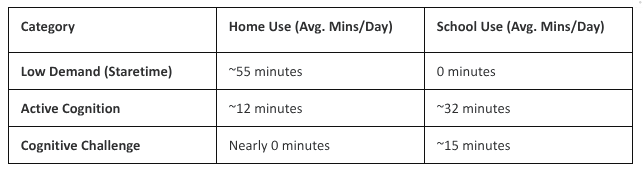
Essentially, while "staretime" dominates the home environment, it is virtually non-existent in school, where the focus shifts toward active and challenging cognitive tasks.
The Perception Gap
There is a significant disconnect between what parents think is happening in the classroom and the reality of the school day. This "Perception Gap" is why educators have such a hard time with "news-bites" from even credible sources that give space to "screen time scaremongering."
The Reality Check
While parental perception suggests that learners spend about 61% of their school day using digital tools, the actual figures are much lower:
Ages 4–6: Only 8% of the day
Ages 6–12: Only 16% of the day
Ages 12–16: Only 29% of the day
Before you think, "Is it really worth investing in 1:1 devices if primary pupils only use them for 16% of the day?" consider this: very few schools actually have 1:1 provision today. And if we surveyed how long each day pupils spent using "books," do you think that figure would be any higher?
The "Paper" Reality
Interestingly, research into classroom pedagogy and time allocation shows that traditional tools are used in a similarly balanced way. In a typical primary setting, children spend approximately 20–25% of their school day actively engaged with exercise books or paper-based writing.
When you compare that 20–25% for books to the 16% for digital devices, it becomes clear that neither tool is "taking over." Instead, they are both parts of a varied toolkit that teachers use to facilitate different types of learning throughout the day. We don't worry about "book time" because we understand its pedagogical value; the data suggests we should view "device time" in schools with the same professional nuance. Some research, for example, indicates that students consistently score higher on comprehension when reading from physical paper. It is not a binary choice.
So, where next?
I believe we should share this information widely among our teaching staff. We need them to feel comfortable and confident when they are increasingly asked to use digital devices across the curriculum.
When teachers know there are strong pedagogical explanations for using these tools, they will use them effectively and judiciously in the curriculum. In talking to parents, they can address concerns about "devices in school" and perhaps even start a productive discussion with parents about how devices are being used at home!
To help you, I decided to see if Notebook LM could come up with a handy info graphic you could use with parents (use this one or make your own). Your prompts are always better as you know your context.
You can find the full research report and the data regarding the "Perception Gap" and usage times here:
Full Report (via Issuu):Changing Learning, Changing Lives – Impact Study
Pedtech Association Website:pedtech.org (This site contains the "PedTech Portal" which hosts the supporting research links and the categorisation of Staretime vs. Cognitive Challenge).
Research and References
Alshammary, F. M., & Alhalafawy, W. S. (2023). Digital platforms and the improvement of learning outcomes: Evidence extracted from meta-analysis. Sustainability, 15(2), 1305.
Ofcom: Children and Parents: Media Use and Attitudes (May 2025) https://www.ofcom.org.uk/media-use-and-attitudes/media-habits-children/children-and-parents-media-use-and-attitudes-report-2025--interactive-data
Screen vs. Paper: Which One Boosts Reading Comprehension? https://oxfordlearning.com/screen-vs-paper-which-one-boosts-reading-comprehension/
The Guardian: "Excessive screen time could limit vocabulary" (January 2026)https://www.theguardian.com/society/2026/jan/11/excessive-screen-time-limits-vocabulary-of-toddlers-experts-warn
"Toddlers, Tech and Talk" Study (November 2024) https://www.qub.ac.uk/News/Allnews/2024/toddlers-tech-talk-study-children-under-three-use-technology.html
Wang JC, Hsieh CY, Kung SH. The impact of smartphone use on learning effectiveness: A case study of primary school students. Educ Inf Technol (Dordr). 2023;28(6):6287-6320. doi: 10.1007/s10639-022-11430-9. Epub 2022 Nov 11. PMID: 36406784; PMCID: PMC9651103.